
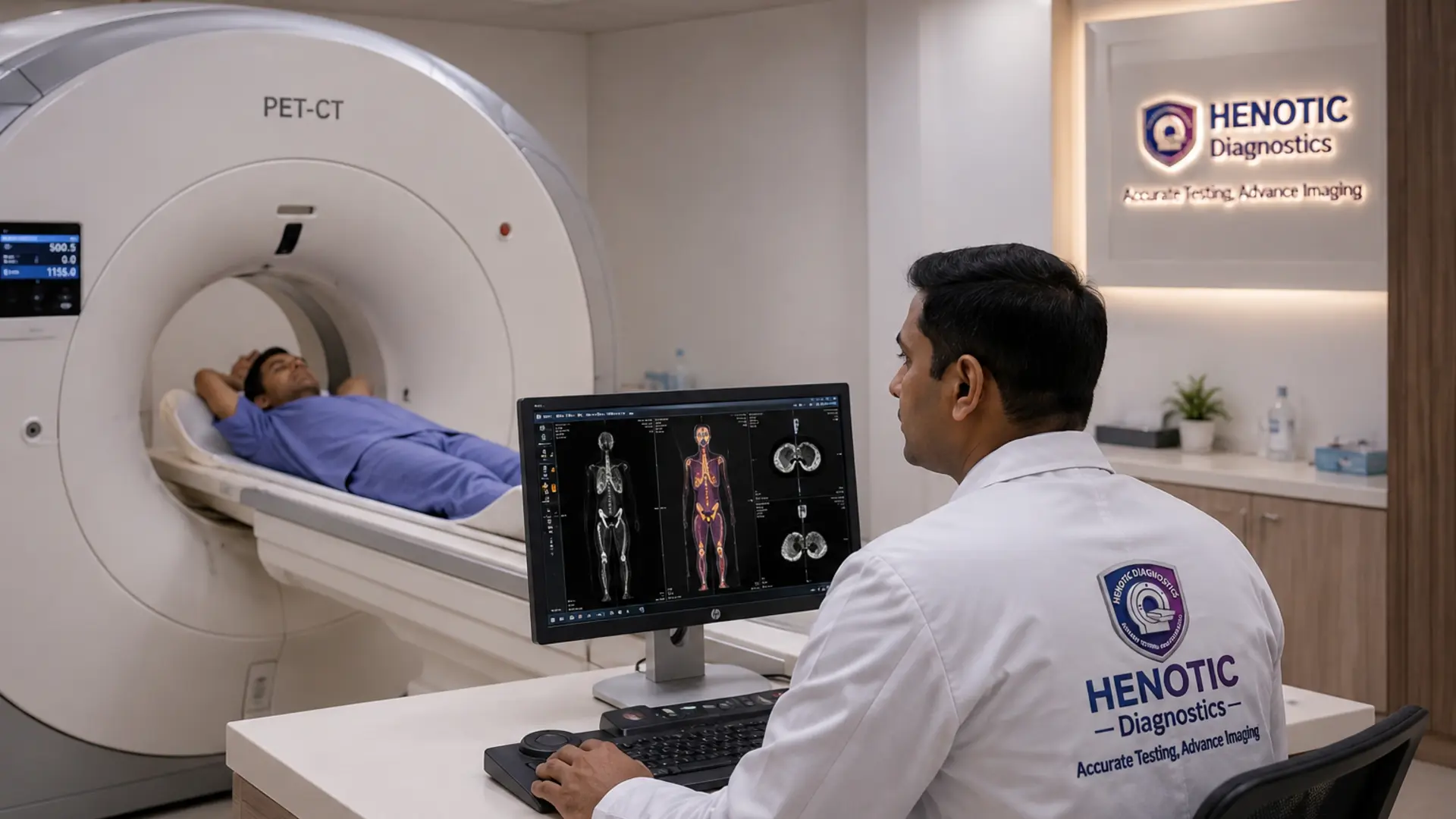
Positron Emission Tomography combined with Computed Tomography (PET-CT) has revolutionized oncological care. By fusing functional cellular metabolism with sub-millimeter anatomical localization, PET-CT detects microscopic disease months before physical structural changes appear on conventional scans.
What Makes PET-CT the Gold Standard in Oncology?
Conventional imaging modalities like ultrasound, standard X-rays, and basic CT scans rely predominantly on structural morphometry — assessing organ enlargement, physical masses, or bone erosion. However, malignant cellular transformations begin long before a tumor grows large enough to deform normal organ anatomy.
A hybrid PET-CT scanner solves this limitation by operating two synchronized imaging engines in a single examination:
- PET (Metabolic Imaging): Detects biochemical activity, cellular glucose utilization, and receptor expression.
- CT (Anatomical Imaging): Provides millimeter-precise 3D anatomical mapping to pinpoint exactly where hypermetabolic activity is located.
How 18F-FDG Radiotracers Highlight Tumors
Cancer cells multiply rapidly and possess an abnormally elevated metabolic rate, consuming up to 20 to 50 times more glucose than normal resting cells (known in biochemistry as the Warburg Effect).
The most common radiotracer used in oncology is Fluorodeoxyglucose (18F-FDG), a glucose analog labeled with positron-emitting Fluorine-18. When injected, hyperactive malignant cells avidly absorb 18F-FDG. Once inside, the tracer is phosphorylated and trapped within the cancer cells. As the isotope decays, it emits pairs of 511-keV gamma photons, which PET scintillators detect to construct high-contrast, luminescent 3D tumor maps.
Strict Blood Sugar & Dietary Fasting Rules
Patient preparation is critical to ensure accurate PET-CT imaging:
- 24 Hours Before Scan: Adopt a low-carbohydrate, no-sugar diet. Avoid strenuous exercise, gym workouts, or heavy lifting, as strained muscle fibers absorb FDG and cause confusing muscle uptake artifacts.
- 6 Hours Strict Fasting: Consume zero food, tea, coffee, milk, or chewing gum. Only pure plain water is permitted.
- Blood Sugar Check: Upon arrival, your capillary blood glucose is tested. Levels must be under 150 to 180 mg/dL. If glucose is excessively high, your scan will be rescheduled or optimized with short-acting insulin protocols under medical supervision.
The 60-Minute Quiet Uptake Room Experience
After intravenous administration of the 18F-FDG radiotracer, you will rest in an individual, climate-controlled, shielded uptake room for 45 to 60 minutes:
- Total Physical Relaxation: You must rest silently without talking, reading, texting, or chewing gum. Vocal cord motion can concentrate FDG in the laryngeal muscles, and eye movements can cause ocular muscle uptake.
- Comfortable Warmth: Keeping warm prevents activation of 'brown adipose tissue' (metabolically active brown fat), which could otherwise light up along the neck and shoulders.
Radiation Safety for Patients and Families
While PET-CT involves low-dose radiation from the radiotracer and low-dose CT component, the clinical benefit of accurate cancer staging, assessing treatment response, or ruling out metastasis vastly outweighs the theoretical risk.
Because 18F has a rapid half-life of 110 minutes, the tracer decays exponentially. By 12 hours, radiation emissions are negligible. Drinking 2 liters of water post-scan accelerates bladder clearance. Patients are advised to keep a 2-meter distance from pregnant women and small infants for 12 hours post-procedure as standard radiation hygiene.
Frequently Asked Questions
Why must my blood sugar be below 150-180 mg/dL for a PET scan?
The PET radiotracer (18F-FDG) is a radioactive glucose analog. If your circulating blood sugar is elevated, natural glucose molecules compete with the radiotracer for tumor cell receptors. This blunts tumor uptake and can lead to false-negative readings or poor image contrast.
How long will I remain mildly radioactive after a PET-CT?
The isotope Fluorine-18 has a short half-life of roughly 110 minutes. Within 6 to 10 hours, the vast majority has decayed and been excreted via urine. As a precaution, avoid prolonged close contact with infants, pregnant women, and young children for 12 hours post-scan.
Is a whole-body PET-CT scan painful?
Not at all. The procedure involves only a small needle prick for the IV line to inject the radiotracer. The scanning process itself is completely silent, non-invasive, and takes approximately 15 to 20 minutes inside the gantry.
Need This Diagnostic Scan?
Henotic Diagnostics provides same-day appointments, 3.0T wide-bore imaging, and NABL-certified reporting across Mumbai & Navi Mumbai.